Keynotes Lectures 2025
Social Preferences and Inequalities: Updates in Behavioral Economics and Experimental Studies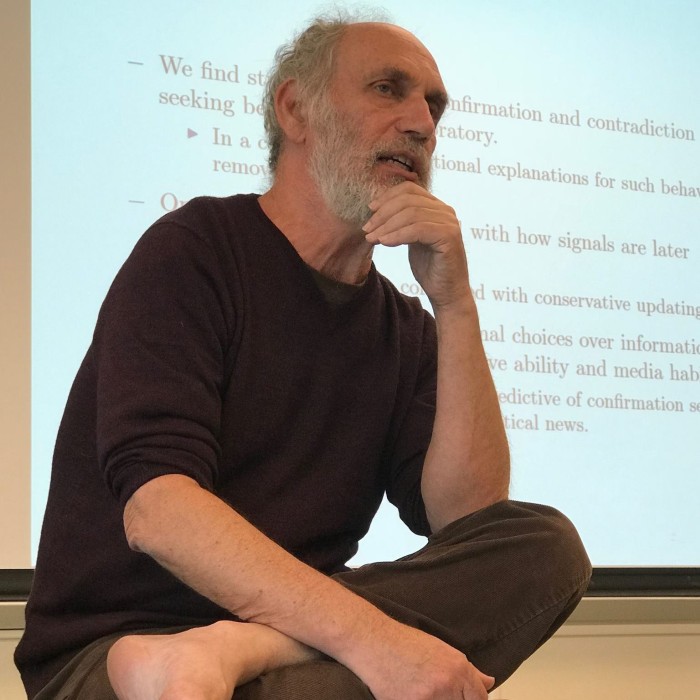
Gary Charness
University of Cagliari, Italy
Gary Charness (born February 3rd, 1950) is a distinguished Professor of Economics and the Director of the Experimental and Behavioral Economics Laboratory at the University of California, Santa Barbara. With an extensive background in experimental and behavioral work, he has become a leading figure in the field of experimental economics, currently holding the 3rd rank worldwide by RePEc. Gary’s expertise extends to various areas of economic research, where he focuses on understanding human behavior and decision-making.
Publication and Board Memberships
As a prolific researcher, Gary Charness has contributed significantly to the advancement of economic knowledge. His research findings have been published in highly regarded journals such as Econometric, American Economic Review, Quarterly Journal of Economics, Journal of Economic Theory, Games and Economic Behavior, and Management Science. In addition to his academic publications, Gary serves on the board of six influential journals, namely the American Economic Review, Management Science, Games and Economic Behavior, Journal of the European Economic Association, Experimental Economics, and Journal of Economic Behavior and Organization.
Key Areas of Research
Gary’s expertise lies in conducting laboratory and field experiments to examine a wide range of economic and social environments. His research touches upon various critical aspects, including social preferences, identity and group membership, communication and beliefs, behavioral interventions, group decision-making, social networks, gender economics, and individual decision-making. A pivotal focus of his work revolves around devising strategies to effect beneficial social outcomes, particularly in challenging economic settings.
Impact and Recognition
The impact of Gary Charness’s research extends beyond academic circles. His findings and insights have been discussed and featured in prestigious media outlets, such as The New York Times and Science, solidifying his reputation as an influential voice in the field of experimental economics.
Personal Life
Outside of his professional endeavors, Gary cherishes his personal life and is happily married with three children. His dedication to both family and academic pursuits demonstrates his commitment to contributing meaningfully to society.

Vittorio Pelligra
University of Cagliari, Italy
TRUST & RECIPROCITY
Trust and Reciprocity: Challenging the Role of Intentions in Economic Decision-Making
A New Perspective on Human Cooperation
Recent research by Vittorio Pelligra and colleagues provides fascinating insights into menu-dependence and reciprocity in economic interactions, challenging how we understand trust-based decisions.
What is Menu-Dependence?
Menu-dependence is a decision process feature where people’s choices are influenced not only by the payoffs of selected options but also by the payoffs associated with alternatives they didn’t choose. This concept is central to reciprocity theories, which suggest we reward others for kind intentions and punish unkind ones. In these models, intentions are evaluated by comparing what a person did against what they could have done but didn’t.
Surprising Experimental Findings
The researchers investigated this mechanism in trust games, testing whether trustworthy responses are affected by the perceived kindness of trustors’ intentions. Through carefully designed experiments with 132 participants at Masaryk University, they discovered:
- No menu-dependence effect – Trustees do not vary their trustworthiness based on the perceived kindness of the trustor’s choice
- Accurate anticipation – Trustors correctly anticipate this insensitivity to changes in kindness
- Intuitive trustworthiness – Decisions to repay trust are more intuitive and faster than self-interested choices
- Speed of trust – The decision to trust comes quicker than selecting outside options when mutual gain is possible
These findings directly challenge predominant reciprocity models (including those by Rabin, Charness and Rabin, Dufwenberg and Kirchsteiger, and Falk and Fischbacher) which predict that willingness to reciprocate should increase with perceived kindness.
Why This Research Matters
This work addresses what Isoni and Sugden called «the paradox of trust» – the fact that most prominent reciprocity models cannot adequately explain mutually beneficial outcomes in trust games. By demonstrating that trustworthy behavior exhibits a form of menu-independence not predicted by theory, the research sheds new light on intentions-based explanations of reciprocal behavior.
The implications extend to:
• Economic theory development
• Mechanism design for effective cooperation
• Public policy implementation
• Business relationship management
• Understanding everyday social interactions
Explore the Mechanics of Trust
Whether you’re an economist, psychologist, business professional, or simply curious about human cooperation, this research offers valuable new perspectives on what drives trustworthy behavior. Understanding these mechanisms doesn’t just advance behavioral science—it helps us design better institutions, businesses, and societal structures.
We invite you to delve deeper into this fascinating intersection of psychology and economics, where intentions, actions, and outcomes shape our social world in unexpected ways.
Interested in learning more about menu-dependence and trust? Contact us to discuss the implications of this groundbreaking research.
Date: Monday, March 24th, 2025
Time: 12:00 PM
Location: FAE Building, 11th Floor

Martín Leites
University of the Republic of Uruguay
Workshop
Social Preferences: Beyond Self-Interest
Applied Microeconomics Workshop
How does economics address issues such as inequality, altruism, justice, and social behavior? This interactive two-session workshop offers an in-depth exploration of behavioral and experimental economics to understand the social preferences that influence our decisions.
What Are Social Preferences?
Social preferences are motivations that go beyond self-interest and affect our economic choices, including fairness, reciprocity, envy, and altruism. These preferences challenge the traditional assumption that individuals act solely to maximize their personal gain.
Workshop Highlights
Under the guidance of Prof. Martín Leites from the University of the Republic of Uruguay, participants will:
- Analyze what truly drives economic behavior beyond selfishness
- Learn about experimental games used to study social interactions
- Discuss the role of reciprocity, justice, and fairness in economic decisions
- Question classical microeconomic assumptions about human nature
Why Attend?
This workshop invites students and researchers to critically reflect on how social values influence economic theory and everyday life. Through interactive activities and discussions, it offers fresh perspectives on cooperation, social norms, and economic behavior.
Who Should Attend?
Economics students and anyone interested in behavioral economics, social decision-making, and broadening their understanding of economic interactions.
For more information or to register, contact us.
We look forward to welcoming you to explore how social preferences shape the economy and our everyday relationships!
Date: Wednesday, June 4th, 2025
Time: 11:15 AM y 15:15 PM
Location: Room 703 and room 705
TRUST AS A COMMON
Is Trust in Crisis? A Conversation on the Glue Holding Society Together
Join us Thursday, March 27th at 11:30 AM in the FAE Auditorium!
In an era of increasing skepticism, understanding the vital role of trust in our daily lives is more crucial than ever. Trust is the «bond of society,» impacting everything from economic performance and education to individual well-being.
Why should you attend?
This engaging talk explores the virtues of trust and the factors that threaten it. Learn how eroding trust can lead to a «tragedy of the commons,» where shared resources are depleted. Discover strategies for building and maintaining trust, fostering a more cooperative and prosperous community.
What we’ll cover:
• The fragility of trust and its impact on social cohesion
• The relationship between interpersonal and institutional trust
• How the erosion of trust can lead to a «tragedy of the commons,» and what we can do about it.
• Solutions for building and maintaining trust
About the Speaker:
PhD. Vittorio Pelligra a renowned expert from University of Cagliari, Italy, will lead this insightful discussion. He brings a unique perspective and wealth of knowledge on the intersection of trust and social well-being.
This event is the first in a series of fascinating talks organized by the Social Preferences and Inequalities team from the Fondecyt project, led by Alejandra Vásquez of the FAE. Don’t miss this opportunity to deepen your understanding of essential societal issues and gain valuable tools for living better together.
See you there!